Contact Detail
Bareilly Road, Budaun, Uttar Pradesh - 243601



Bareilly Road, Budaun, Uttar Pradesh - 243601

Talk to ten different parents about why they picked their child's school, and you'll hear ten slightly different answers — yet most of them circle back to the same handful of things once you dig a little deeper. Choosing a school isn't really about finding the fanciest campus or the highest-scoring batch from last year. It's about finding a place that fits how your child actually learns and grows. Here's what tends to matter most, and how to check for it in person — using BRB Model School, Budaun, as a practical example while you look.
Before touring a single classroom, it's worth asking a blunt question: is this school optimizing for exam scores, or for the kind of person a child becomes along the way? A school with real purpose can explain this without resorting to buzzwords — and you'll see it reflected in small things, like how a teacher responds when two students argue in the hallway.
Nothing shapes a child's daily experience like the adult standing in front of their class. While visiting, pay attention to a few specific things: whether teachers are properly trained and keep learning themselves, whether they come across as patient rather than rushed, whether staff tend to stay for years rather than cycle through quickly, and whether class sizes are small enough that no child quietly disappears into the back row.
There is a big difference between preparing students to reproduce information in an exam and helping them develop a genuine understanding of what they learn. Meaningful education encourages children to apply their knowledge, think independently, and connect classroom lessons with real-life situations.
Parents should ask how subjects such as reading, mathematics, and science are taught. Are students given opportunities to participate in activities, experiments, discussions, and projects, or is learning mainly based on textbooks and repetition? It is equally important to understand how the school supports children who need additional help and those who are ready for greater challenges. Parents should also check the school’s board affiliation—whether CBSE, ICSE, or State Board—and consider how it aligns with their child’s future educational plans.
A child who doesn't feel safe rarely learns well, no matter how good the teaching is. Confirm the basics yourself: controlled entry points, working CCTV with staff actually monitoring it, a transport system you'd trust with your own child, clean water and washrooms, and a bullying policy that's enforced rather than just printed in a handbook. And when it comes to discipline, there's a real difference between firm-but-fair and simply harsh — the first builds structure, the second just builds fear.
You don't need a school with a five-star campus. What you need is one where the classrooms are bright and properly ventilated, the library actually gets visited, the labs are more than just a locked room for inspection day, and there's a playground kids genuinely use. Ask less about what the school has, and more about how often it's actually in use.
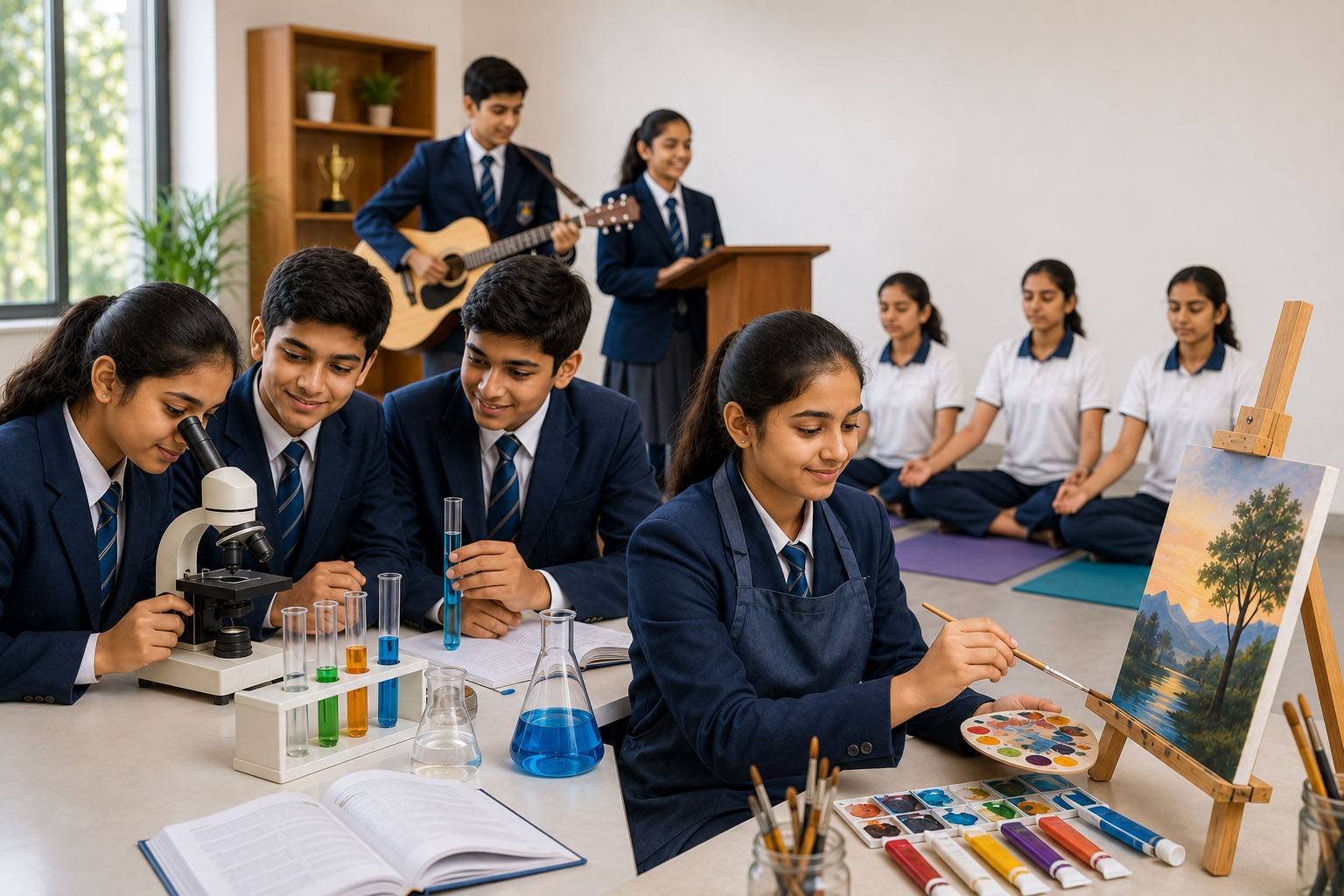
A child who discovers they're good at debate, or football, or painting often carries that confidence straight back into their academics. Schools that treat these activities as a core part of growing up — not a once-a-year event — tend to produce more well-rounded, self-assured students.
Good schools don't treat parents as outsiders to be updated occasionally — they treat you as part of the process. Regular PTMs, clear and honest progress updates, and teachers who actually respond when you reach out are all signs of this. And a useful early test: if a school is hard to get a straight answer from before you've even enrolled, that pattern rarely improves later.
Grades get a child through admissions and applications. Character Shapes How Children Navigate Life. Look for schools that genuinely build honesty, empathy, communication, and leadership into daily routines — value education, community service, and similar initiatives are usually a good sign this isn't just talk.
Commute time, transport reliability, and a fee structure your family can sustain for years — not just this year — all deserve honest consideration. A slightly less prestigious school that's twenty minutes closer to home can sometimes be the better choice once you account for your child's actual day-to-day energy and time.
After all the checklists, there's still something to be said for simply walking the halls and paying attention. Do the students look genuinely engaged, not just quiet and compliant? Does the place feel calm without feeling rigid? Could you picture your own child feeling at home there?
If BRB Model School is on your list, bring these questions along rather than relying on the prospectus alone. Ask to meet teachers directly, walk through the actual classrooms and labs, ask pointed questions about safety and curriculum, and if you get the chance, talk to a parent who's already sending their child there. A visit on a completely ordinary school day will teach you more than any planned tour ever could.
There's no such thing as a universally "best" school — only the one that's genuinely right for your child. Look for strong teaching, real safety, a place where your child can grow as more than just a student, and trust both your research and your instincts once you've seen it for yourself.